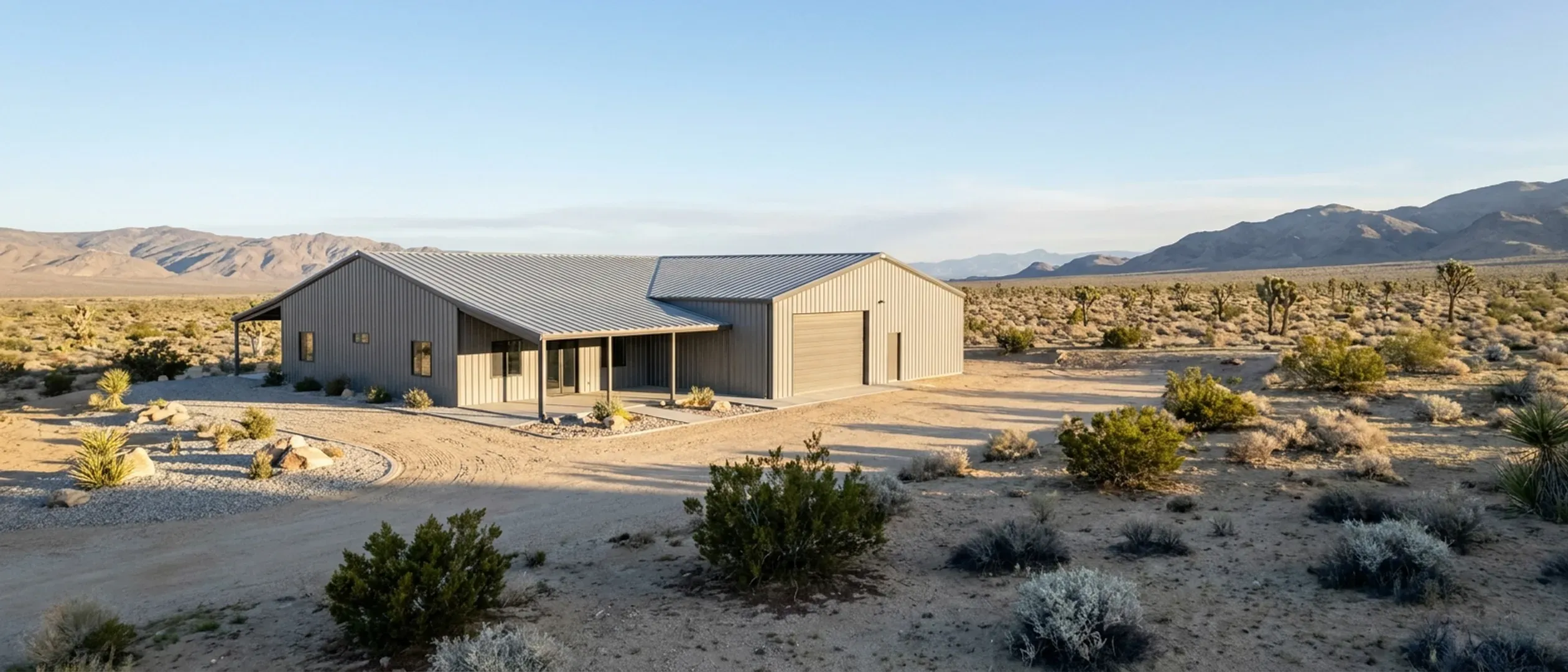
Barndominium Financing in Nevada: Construction Loans, USDA and Rural Lenders
Most barndominiums in Nevada are built on land the owner already holds or is buying, by a contractor the owner hires. That makes the loan a construction loan, not an ordinary mortgage, and it narrows the lenders who will write it. This guide covers the federal programs that fund construction and what their rules say, where in Nevada USDA Rural Development can lend, the Farm Credit lenders that serve rural Nevada, and what a lender will ask for before the first draw. Rates change monthly and depend on the borrower, so the only rate on this page is one a federal agency published, with its date.
Figures on this page are cited third-party or government data, not a quote from Nevada Barndominium Builders.
Bottom Line Up Front
- A barndominium on your own land is usually financed with a construction loan, and the simplest version converts to a permanent mortgage at one closing. USDA's guaranteed program allows that kind of combination loan under 7 CFR 3555.101.
- USDA Rural Development's 2023 Nevada map notice lists Las Vegas, North Las Vegas, Henderson, Reno and Sparks, including areas annexed since 1990, as ineligible. Much of the rest of the state must be checked address by address on USDA's eligibility map.
- Farm Credit lenders serve rural Nevada. American AgCredit lists offices in Elko, Fallon and Reno and publishes rural home loans that can include barns and shops in the appraised value.
The loan types that fund a build
A lender funds a build in stages, and the loan has to cover the time before the house exists. These are the structures that do that.
Construction-to-permanent (one closing)
One loan funds the land if needed and the construction draws, then converts to a mortgage when the house is finished. American AgCredit describes its version as one loan, one set of fees and one closing, with interest-only payments and the rate locked during construction.
Two-closing construction loan
A short-term construction loan that is paid off by a separate permanent mortgage at completion. It means two sets of closing costs and a second approval when the house is done.
Lot or land loan first
If you are buying land now and building later, some rural lenders make lot loans. American AgCredit says improvements like power, well and septic are not typically required for its lot loans, and a lot loan can be switched into a construction loan when you are ready.
Conventional limits
FHFA set the 2026 baseline conforming loan limit for a one-unit property at $832,750, up $26,250 from 2025. A loan above the limit that applies to your county is a jumbo loan, with its own lender requirements.
USDA Rural Development in Nevada
USDA has two single-family programs, and both can fund a new house in an eligible rural area.
Section 502 Guaranteed
Guaranteed loan funds may be used for the construction or purchase of a new dwelling used as a principal residence (7 CFR 3555.101), and eligible costs include site preparation, foundation and driveways. USDA's program page describes 100 percent financing for eligible applicants through approved lenders, with income up to 115 percent of area median household income.
Combination construction and permanent loan
Under 7 CFR 3555.101(c), USDA will guarantee a combination construction and permanent loan during construction and before the borrower moves in. The lender needs two or more years of construction-lending experience, and the builder must meet the experience, licensing and insurance conditions in 3555.105.
Section 502 Direct
For low- and very-low-income applicants, USDA lends directly. Funds can be used to build, and to purchase and prepare sites including water and sewage facilities. USDA's Nevada program page listed a rate of 5.250 percent effective 1 September 2026, which payment assistance can reduce. That is USDA's published figure, and it changes.
What USDA will not fund
Under 7 CFR 3555.201 the site must be typical in size for the area and must not include income-producing land or buildings. Property used primarily for agriculture, farming or commercial enterprise is ineligible. A barndominium whose shop runs a business, or a working ranch parcel, is a conversation to have with the lender early.
What a lender will ask for
Construction lenders underwrite the project as well as the borrower. Have these ready before you apply.
Plans and specifications
A complete set of plans, the kit supplier's documents, and a line-item budget that separates the building from site work, well and septic.
The builder's contract and credentials
A fixed contract with a Nevada-licensed contractor, with the licence number, insurance certificates and a draw schedule. Programs like USDA's combination loan set minimum builder experience and insurance.
Land documents
The deed or purchase contract, a survey or parcel map, legal access, and evidence of how water and wastewater will be handled: a well plan or water service letter, and a septic approval or sewer connection.
An appraisal plan
The loan amount depends on the appraised value of the finished home. Ask the lender how its appraiser will value a steel or post-frame home on acreage, and whether the shop is included. American AgCredit says barns, shops and outbuildings can be included in the appraised value under its rural home loans.
Reading this because you are weighing a build? The next step is a plan drawn for your program.
What's different about Nevada
USDA's urban exclusions are specific
USDA Rural Development's Nevada notice on the 2020-census map review expanded the ineligible areas around Las Vegas, North Las Vegas, Henderson, Reno and Sparks to include all areas annexed since 1990, effective 1 October 2023. It does not say everything else is eligible, so check each address on USDA's map.
The builder has to qualify too
For a USDA guaranteed combination construction and permanent loan, the builder needs two or more years of experience building similar homes, any state-issued contractor licence the law requires, and at least $500,000 of general liability cover (7 CFR 3555.105). In Nevada, construction work is performed by contractors licensed by the Nevada State Contractors Board.
Property tax on a new home
Nevada caps the annual property-tax increase on an owner's primary residence at 3 percent, but the value of new construction is added outside that cap (NRS 361.4723). Budget the first full-year tax bill on the finished house, not on the bare land.
Owner-builders and lenders
Nevada allows an owner-builder exemption for a home you will live in. You apply to the Nevada State Contractors Board, supervise the work directly and use licensed subcontractors (NRS 624.031). Selling or leasing the home within a year of completion is presumed to defeat the exemption. Ask any construction lender whether it will lend to an owner-builder before you rely on the exemption.
Can you get a USDA loan for a barndominium in Nevada?
Is Pahrump or Elko eligible for USDA loans?
Who lends on rural land and barndominiums in Nevada?
What is the conforming loan limit in Nevada for 2026?
Can I be my own builder and still get a construction loan?
Will my property taxes jump after the house is built?
Does the shop count toward the loan?
Questions answered? Tell us about your land and what you want to build.
Sources
- eCFR — 7 CFR 3555.101 Loan purposes (Section 502 Guaranteed) — incl. (c) combination construction and permanent loans; read 26 Sep 2026
- eCFR — 7 CFR 3555.105 Combination construction and permanent loans — lender and builder conditions
- eCFR — 7 CFR 3555.201 Site requirements
- eCFR — 7 CFR 3550.52 Loan purposes (Section 502 Direct)
- USDA Rural Development — Notice of changes to eligible area maps, Nevada — effective 1 Oct 2023
- USDA — Property and income eligibility site
- USDA Rural Development — Single Family Housing Direct Home Loans in Nevada — rate effective 1 Sep 2026; read 26 Sep 2026
- USDA Rural Development — Single Family Housing Guaranteed Loan Program
- FHFA — Conforming Loan Limit Values for 2026 — released 25 Nov 2025
- Farm Credit — Nevada
- American AgCredit — Rural Home Loans
- American AgCredit — Locations
- NRS 361.4723 (partial abatement of taxes), via nevada.public.law
- Nevada State Contractors Board — Owner-Builder Information
Keep reading
The pages that answer the next question this one raises.
What a barndominium costs in Nevada
The sourced figures and site costs a construction budget has to carry.
Read itWhat size can your budget build?
Turning a loan amount into a footprint.
Read itBarndominium vs. house cost
Where the money goes in each.
Read itTurnkey builds
How a single-contract build is organised.
Read itRanges are a starting point. Your land is the answer.
Start the survey and tell us about your land and what you want to build. Include the county and parcel ID if you have them, because in Nevada the jurisdiction, the water source, the septic answer and how far materials travel to the parcel change the budget more than the building does. The survey costs nothing.