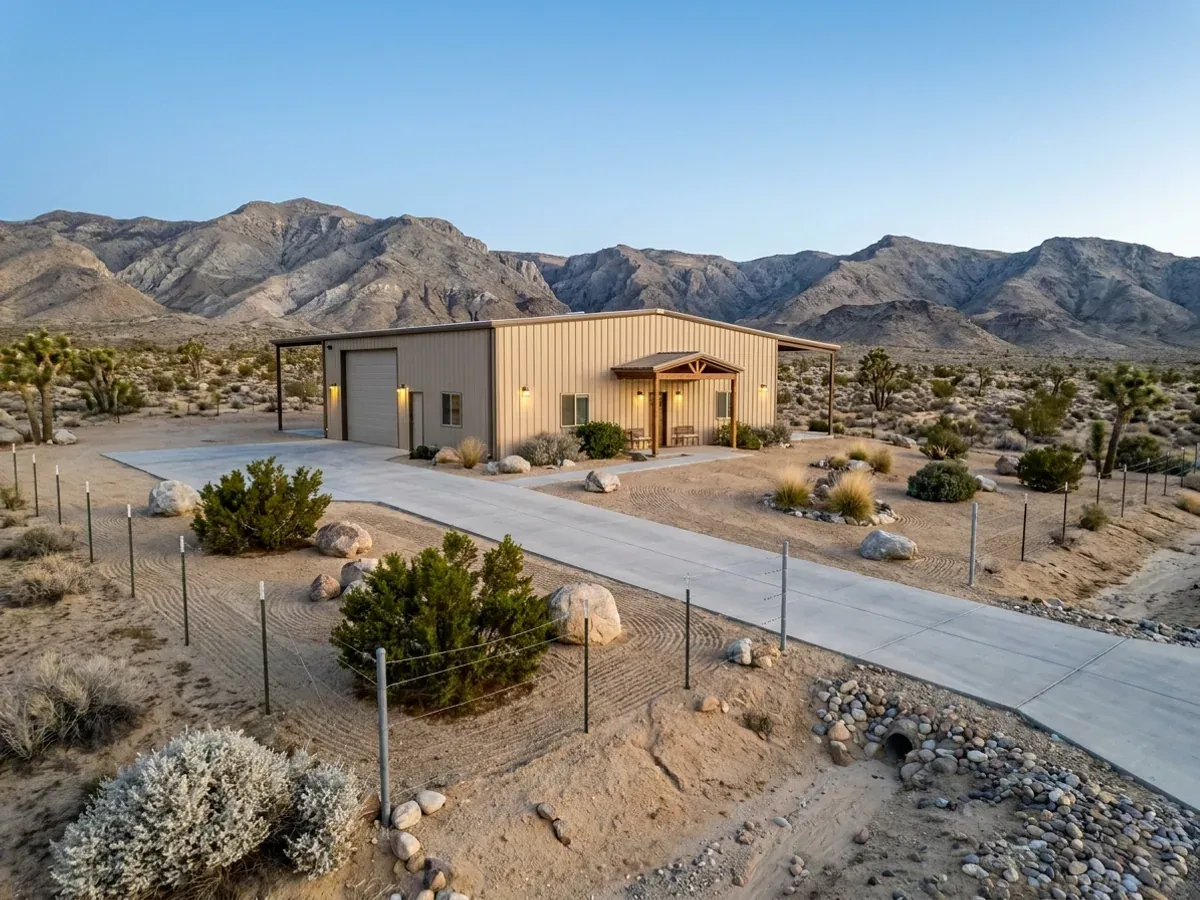
Turnkey Barndominium Builds in Nevada
A turnkey build takes a barndominium from bare land to a finished, inspected home you can move into, under one plan and one schedule instead of a dozen separate hires. The construction itself is carried out by Nevada-licensed contractors, and the sequence is set around the things that decide a Nevada build: land that is often far from utilities, septic and water approvals from different agencies in the south and the north, soils reports, and weather windows between summer heat, monsoon storms and high-desert winters. You get one set of drawings, one written scope and one point of contact from the parcel to the certificate of occupancy.
Turnkey Builds: how the work runs
Four stages, in this order. The sequence matters more than it looks: getting the soils report, the septic and water answers and the design values settled before anything is fabricated is what keeps a Nevada build from stalling.
Feasibility on the parcel you have or want
Before anything is priced, the parcel is checked for what it will actually allow: zoning and whether a dwelling is permitted, legal and physical access, the nearest sewer and water service, flood zone, and whether a well or septic system is realistic. In southern Nevada the Southern Nevada Health District issues new septic permits only where the property is more than 400 feet from the nearest community sewer connection, and it wants proof of an approved water source first. Answers like those decide whether the budget is a house budget or a utilities budget.
Plans, calculations and the written scope
The plan set, the structural calculations sealed by a Nevada-licensed professional engineer where required, and a written scope follow. The scope lists every inclusion and exclusion — site work, foundation, frame, envelope, mechanical, electrical, plumbing, finishes, septic, well or water service, driveway and power — so the finished house is defined on paper before any contract is signed with the contractor carrying it out.
Permits and the construction sequence
The building permit is issued to the licensed contractor of record, or to you if you build as an owner-builder under the Nevada State Contractors Board's exemption. Construction then runs in the order inspections demand: site and foundation, frame, rough mechanical, electrical and plumbing, insulation, drywall and finishes. On a remote parcel, trades and deliveries are grouped so a crew makes one long trip instead of several.
Final inspection, certificate and handover
The job ends with the building department's final inspection and the certificate of occupancy, plus the septic final from the health authority where one applies. You receive the approved plans, the inspection record, equipment manuals and warranty documents, and a walkthrough of the systems — the well and pressure tank, the septic tank's pumping schedule, the evaporative cooler's seasonal maintenance — that a first-time rural owner needs to run the house.
In Nevada, "builder" and "contractor" are the same word in law
Nevada's contractor law says a contractor is synonymous with a builder, and it reaches anyone who undertakes, offers to undertake or submits a bid for construction — including a construction manager paid a fee to direct a project. It also treats taking out a building permit as prima facie evidence of acting as a contractor. So a turnkey barndominium is carried out by a general contractor licensed by the Nevada State Contractors Board, or by you as an owner-builder under the Board's exemption. Before you sign with anyone, ask for the licence number and look it up on the Board's website: the record shows the classification and the monetary limit the Board has set for that licence.
Turnkey Builds across Nevada
In Nevada the line that matters is the building department's. Clark County and its cities work from the Southern Nevada amendments to the 2024 codes; Washoe and Douglas counties from the Northern Nevada amendments; Nye County's department lists the 2018 codes for Pahrump. Septic goes to the Southern Nevada Health District in the south and Northern Nevada Public Health around Reno. Cross a county line and what changes is the wind, snow and seismic values on the drawings, the soils report the department expects, who approves the septic system and what the fees are.
Barndominium projects across Nevada.
Every county has its own reviewer, fee schedule and published design values. The service area pages set out what each one publishes.
What actually decides the price
Square footage is the number everyone leads with, and it is rarely the one that moves a barndominium budget. These four do.
-
Distance and access to the parcel
Most of Nevada is federal land — the Bureau of Land Management manages about 63 percent of it — so private parcels are often scattered and remote. Every mile of dirt road adds haul time for concrete, steel and crews, and every site visit by an inspector or a trade costs more when it takes half a day to get there. A parcel with a maintained road and nearby power can save more money than any finish choice.
-
Utilities you have to bring in
Power line extension, a well and pump or a water-service connection, a septic system and propane storage can together rival the cost of the building's shell on a rural parcel. Each is decided by a different party: the electric utility's line extension terms, the water purveyor or the Nevada Division of Water Resources for water rights, and the county health authority for septic. The turnkey scope lists each one with its own allowance so none of them is a surprise.
-
Fees your county charges
Plan review, building permit, septic permit, grading and impact fees are set by the jurisdiction and paid on every project. They vary widely. Nye County's building department, for example, posts impact fees of $8,915.97 effective 13 January 2025, and fees elsewhere follow each county's own schedule. Ask your building department for its current fee schedule and include every line in the budget before the contract is signed.
-
Season and schedule
Nevada's calendar shapes a build. Clark County's Regional Flood Control District warns of sudden downpours and flash flooding in the July-to-September monsoon, the National Weather Service describes summer heat in the triple digits, and northern high-desert parcels face frozen ground and snow in winter. Concrete placed in extreme heat or cold needs extra measures, and dirt access roads can close after storms. A schedule that plans around those windows costs less than one that fights them.
Turnkey Builds in Nevada: common questions
8 questions about building in Nevada. If yours is not on the list, put it in the survey and we will answer it.
What does "turnkey" include on a Nevada barndominium?
Who actually carries out the construction?
Can I act as my own general contractor instead?
How long does a turnkey barndominium take in Nevada?
Can you help me find land for a barndominium?
What happens if something is wrong after I move in?
How is a turnkey build paid for?
Can a turnkey barndominium include a shop?
Keep reading
The pages that answer the next question this one raises.
Ready to put turnkey builds against a real plan? Start there and the rest follows.
Tell us about the land
Tell us where the parcel is and what you want on it. We will come back with who has jurisdiction, the design values and approvals it needs, and what the land needs before it can be built on. Starting the survey costs nothing.