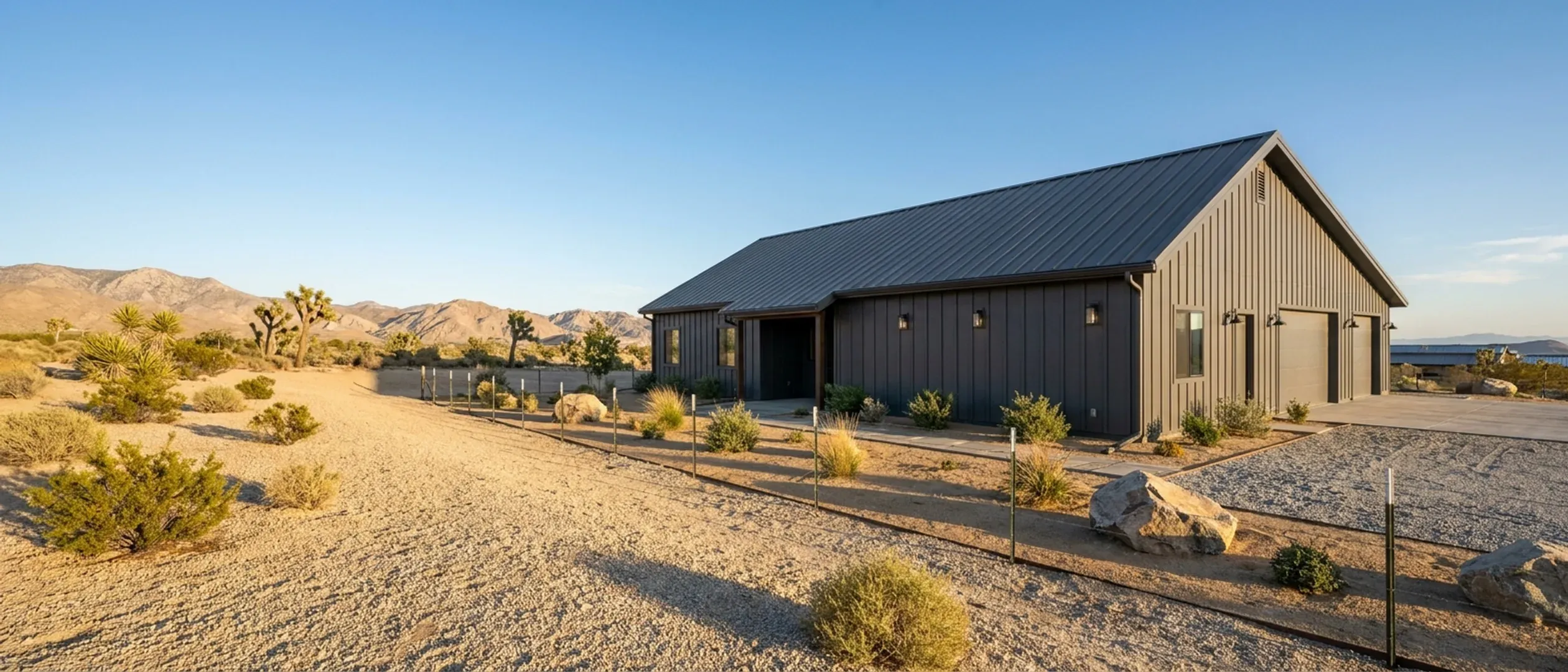
Barndominium Pros and Cons in Nevada: Heat, Cold, Water, Insurance and Resale
A barndominium's strengths are the same everywhere: a fast shell, wide clear spans, and a shop and a home under one roof. Its weaknesses are the ones that show up wherever a house is unusual: appraisals, insurance questions and neighbours' covenants. What changes in Nevada is the setting. The land is mostly federal, so private parcels are scarce and often remote; the climate runs from Las Vegas summers averaging above 104°F in July to Elko winter nights averaging near 11°F in January; and water and septic approvals decide more parcels than zoning does. This guide weighs the pros and cons against those Nevada conditions, cites the source for each Nevada fact, and leaves prices out — the cost guides cover those, with their sources.
Figures on this page are cited third-party or government data, not a quote from Nevada Barndominium Builders.
Bottom Line Up Front
- The biggest advantage is fit: a large shop, garage or equipment bay joined to a home on acreage, with a shell that goes up quickly and spans wide without interior posts.
- The biggest Nevada-specific risks are not the building: water (a domestic well is limited to one home and 2 acre-feet a year, and Pahrump requires buying water rights), septic approval, and HOA covenants in planned communities.
- Resale and insurance are manageable but need homework: appraisers must find comparable sales, which Fannie Mae acknowledges can be scarce on rural land, and insurers price on factors like fire protection, flood zones and earthquake faults.
The advantages, weighed for Nevada
What a barndominium genuinely does better — and where the Nevada setting strengthens or limits the advantage.
Shop and home under one roof
The defining advantage. On acreage outside the metro areas, a heated shop, equipment bay or RV garage joined to the living space is often the reason to build one at all. Check that your zoning allows the shop's intended use; home businesses and outbuildings are local zoning questions.
Wide clear spans and flexible layouts
Steel frames and post-frame construction carry the roof on the exterior frame, so interior walls can go where you want them and be moved later. Great rooms and tall ceilings are straightforward.
A fast shell
Once the foundation passes inspection, the frame and envelope go up quickly, which shortens the time the site sits open to summer heat or winter weather.
Durable, low-maintenance exterior
Metal roofing and siding do not rot, and steel framing is not food for termites. Finishes still need attention, and fasteners and trim should be checked over time.
An owner-builder route
Nevada's owner-builder exemption lets you build a home for your own occupancy without a contractor's licence, on its conditions: you apply to the Nevada State Contractors Board, supervise the work yourself, use licensed subcontractors, and do not sell or lease within a year of completion (NRS 624.031(5)).
The disadvantages, weighed for Nevada
Most of these are solvable. None of them is solved by the steel.
Appraisal and resale
Fannie Mae's Selling Guide tells appraisers that comparable sales should have similar physical and legal characteristics, including style, and acknowledges that rural properties may have a shortage — or absence — of recent truly comparable sales, allowing distant or older comparables with an explanation. A barndominium on remote Nevada land can therefore appraise off sales that are far away or old, which affects both your loan and your eventual buyer's.
Water and septic decide the parcel
A domestic well serves one home and is limited to 2 acre-feet a year without a water-right permit (NRS 534.180). In the Pahrump Artesian Basin a new domestic well first requires relinquishing at least 2 acre-feet of existing water rights (State Engineer Order 1293A). In Clark County, new residential septic is permitted only more than 400 feet from sewer, and properties on Colorado River water need a Southern Nevada Water Authority waiver.
HOA covenants in planned communities
Where a common-interest community's governing documents give it architectural control, a shop-style or metal-clad home needs its approval, and the association can impose construction penalties for missing its build schedule (NRS 116.310305). Land outside any common-interest community carries no association approval.
Heat, cold and condensation need design
Metal transfers heat readily. In the south that means solar gain and cooling load; in the north, condensation risk at cold steel surfaces. Both are handled by insulation and air and vapour control detailing, and both cost money if skipped.
Flash floods on alluvial land
The Nevada Division of Insurance notes that despite the dry climate, heavy rains, flash floods and spring snowmelt are regular annual occurrences, and standard homeowners policies exclude flood. Check the parcel's flood-zone status and drainage before choosing a pad location.
Unfamiliarity with lenders and insurers
Some lenders and insurers see few barndominiums. Expect more questions about the frame, cladding and the shop's use, and allow time to shop for both.
Who a barndominium suits in Nevada
A quick way to weigh the list above against your own plans.
A strong fit
Owners with acreage outside a planned community, a real need for shop, equipment or RV space, a confirmed water source and septic approval path, and plans to stay long enough that appraisal comparables matter less.
A harder fit
Buyers on a small lot inside an HOA, anyone who expects to sell within a year or two, and parcels where water rights or septic approval are still open questions.
Worth a second look
Parcels in the Pahrump basin (budget for water rights), Clark County valley lots (confirm sewer or septic eligibility), and land next to a city in the smaller counties (a city's stricter code can reach a mile outside its limits under NRS 244.368).
Reading this because you are weighing a build? The next step is a plan drawn for your program.
What's different about Nevada
Desert heat makes the envelope the priority
The Western Regional Climate Center's long-term record for Las Vegas McCarran Airport puts the mean July high at 104.5°F. A metal roof and walls with a continuous insulation and air-sealing strategy handle that well; a thinly insulated shell does not. Every building department that has adopted a code must enforce the statewide energy code, which the Governor's Office of Energy updated to the 2024 International Energy Conservation Code (NRS 701.220), so the living space is held to the same energy standard as any new house.
Northern cold and condensation
The same record puts the mean January low at 20.9°F in Reno and 10.9°F in Elko. In cold weather, warm interior air meeting cold steel is where condensation starts, so the vapour control and insulation details at the roof and walls matter more in northern and northeastern Nevada than the frame itself. Snow load and frost depth for your roof and footings come from your county or city building department.
Seismic design is required everywhere a code is adopted
Nevada law requires every local building code to include the seismic provisions of the International Building Code and standards for investigating seismic hazards such as surface rupture and liquefaction (NRS 278.580(6)). A pre-engineered steel or post-frame building is designed to those loads like any other; the seismic design category for your site comes from your building department.
Private land is scarce and often remote
The Bureau of Land Management manages nearly 48 million acres, about 63 percent of Nevada's land. That is part of the appeal — open land and space for a shop — and part of the cost: remote parcels mean longer utility runs, private wells and septic, and fewer nearby home sales for an appraiser to compare against.
Insurance questions to ask early
The Nevada Division of Insurance says insurers set premiums on factors such as proximity to a fire house, proximity to flood zones or earthquake faults and age of home, plus the cost to rebuild. It also notes that flood and earthquake are standard exclusions needing separate cover, and that Nevada law does not require homeowners insurance but lenders can. For a barndominium, ask an insurer to price the policy before you commit to a plan: tell the insurer the frame and cladding, the shop's use and contents, and the distance to the nearest fire station.
Property tax: the new house is added before the cap applies
Nevada caps the annual increase in the tax bill on an owner's primary residence at 3 percent, but a newly built house is added to the assessment outside that cap (NRS 361.4723). Plan on the first full assessment after completion reflecting the new building.
Pros and cons, honestly
Pros
- Shop, garage or equipment space joined to the home on one foundation and roof.
- Wide clear spans allow open, changeable floor plans.
- The shell is erected quickly once the foundation passes inspection.
- Metal roofing and siding resist rot, and steel framing is not food for termites.
- Nevada's owner-builder exemption allows building your own home for your own occupancy, on its conditions.
- Held to the same statewide energy and seismic floors as any new house, so a well-built one performs like one.
Cons
- Appraisers may have to use distant or older comparable sales on rural land.
- Water limits: one home per domestic well, 2 acre-feet a year, and a water-rights purchase in Pahrump.
- Septic may be unavailable on Clark County valley lots near sewer or on Colorado River water.
- HOA architectural control can block or delay a shop-style home.
- Heat gain in the south and condensation in the north need careful envelope design.
- Some lenders and insurers ask more questions about an unfamiliar building type.
- The new house is added to the property-tax assessment outside Nevada's 3 percent cap.
What are the main pros and cons of a barndominium in Nevada?
Are barndominiums good in the Las Vegas heat?
Do barndominiums have condensation problems in northern Nevada?
Is a barndominium hard to insure in Nevada?
Do barndominiums hold their value in Nevada?
Can I build a barndominium in a Las Vegas or Reno HOA?
Does a barndominium raise my property tax?
Questions answered? Tell us about your land and what you want to build.
Sources
- Western Regional Climate Center — Las Vegas McCarran AP monthly average maximum temperature — period-of-record means, file updated 4 Apr 2013
- Western Regional Climate Center — Reno Tahoe Intl AP monthly average minimum temperature — period-of-record means
- Western Regional Climate Center — Elko Regional AP monthly average minimum temperature — period-of-record means
- Nevada Division of Insurance — Homeowners Insurance — premium factors and exclusions; read 26 Sep 2026
- Nevada Division of Insurance — Flood Insurance — read 26 Sep 2026
- Fannie Mae Selling Guide B4-1.3-08 — Comparable Sales — rural properties; read 26 Sep 2026
- Bureau of Land Management — What we manage: Nevada — nearly 48 million acres, about 63 percent
- NRS Chapter 278 — Planning and Zoning (archived copy, Rev. 9/9/2026) — 278.580(6) seismic provisions
- NRS Chapter 534 — Underground Water and Wells (archived copy) — 534.180 domestic wells
- Nevada Division of Water Resources — State Engineer Order 1293A — Pahrump Artesian Basin
- NRS 361.4723 — partial abatement of property taxes (Nevada Public Law mirror) — via statewide research X1/X2
- NRS Chapter 624 — Contractors (archived copy, Rev. 4/15/2026) — 624.031(5) owner-builder
- NRS Chapter 116 — Common-Interest Ownership (archived copy) — 116.310305
Keep reading
The pages that answer the next question this one raises.
Are barndominiums worth it in Nevada?
Weighing cost, resale, water and land against what you need the building to do.
Read itAre barndominiums legal in Nevada?
Permits, owner-builders, wells, septic and HOA rules.
Read itBarndominium cost in Nevada
Third-party cost figures, with their sources.
Read itShouses
Shop-and-house layouts for Nevada acreage.
Read itTell us about your land
Start the survey with your parcel's location and what you want to build.
Read itRanges are a starting point. Your land is the answer.
Start the survey and tell us about your land and what you want to build. Include the county and parcel ID if you have them, because in Nevada the jurisdiction, the water source, the septic answer and how far materials travel to the parcel change the budget more than the building does. The survey costs nothing.