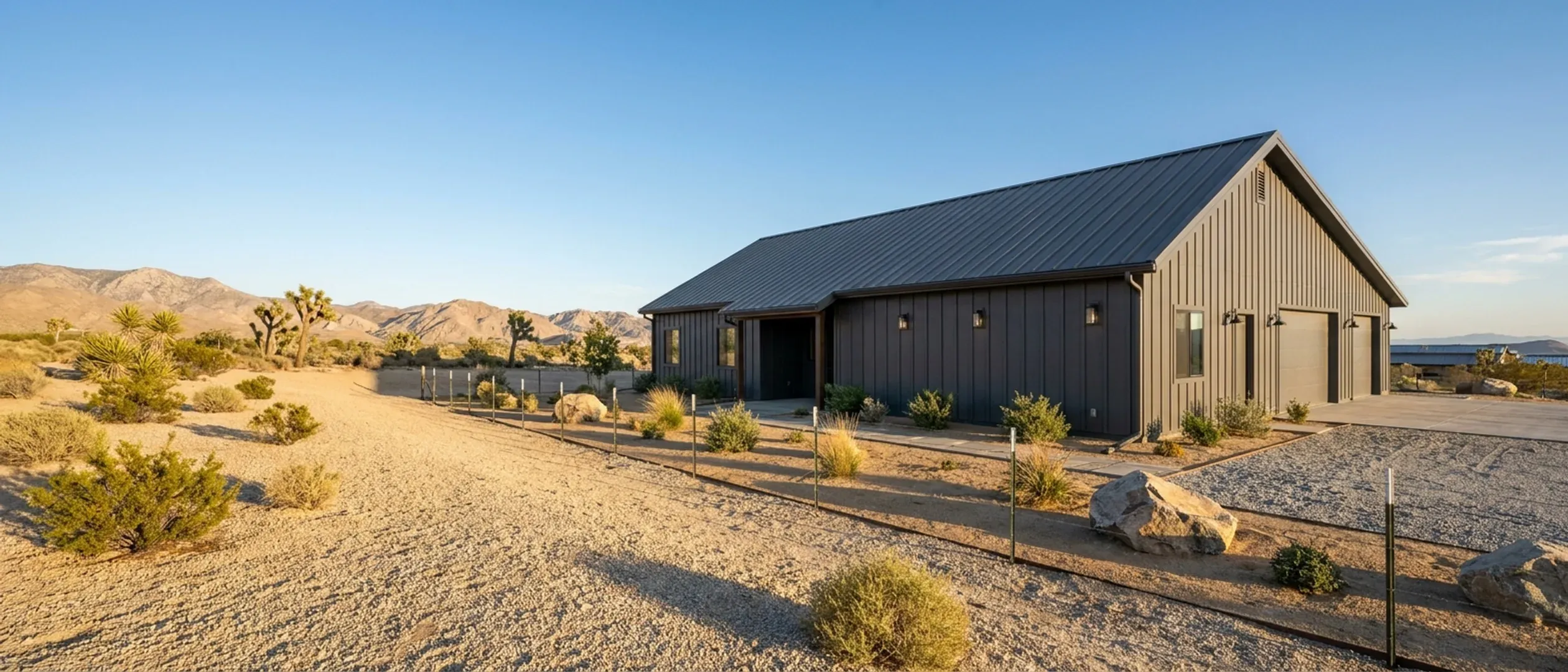
Are Barndominiums Legal in Nevada? Permits, Owner-Builders, Wells and HOAs
No Nevada statute bans a barndominium. The Nevada Revised Statutes do not mention the building type at all, and nothing in state law says a house must be framed in wood or clad in stucco. A steel or post-frame home is a single-family dwelling like any other, and it is judged against whichever building code the city or county has adopted. That is the real answer, and it is also why the question matters: Nevada leaves building codes to local government, so the rules that actually decide your project sit with the county, the city, the health district that approves septic, the State Engineer if you are drilling a well, and — in a master-planned Las Vegas or Reno suburb — the homeowners association. This guide walks through each of those in the order you will meet them, cites the statute or the agency page behind every rule, and says plainly where Nevada's rules vary by place rather than pretending there is one statewide answer.
Figures on this page are cited third-party or government data, not a quote from Nevada Barndominium Builders.
Bottom Line Up Front
- A barndominium is legal in Nevada. State law does not regulate the building type; the city or county that adopted a building code reviews it like any other house (NRS 278.580).
- Construction must be done by contractors licensed by the Nevada State Contractors Board, unless you qualify for the owner-builder exemption for a home you will live in yourself — and that exemption has conditions (NRS 624.031(5)).
- The deal-breakers are usually local and underground: water (a domestic well is limited to one home and 2 acre-feet a year; Pahrump adds a water-rights purchase), septic approval from the right health authority, and HOA covenants in planned communities.
Who issues your permit
The permit comes from the building department of the jurisdiction the parcel sits in. In Nevada that is a question with more than one possible answer, so settle it before anything else.
Unincorporated land: the county
Outside city limits the county building department issues the permit. Much of the Las Vegas Valley — Paradise, Spring Valley, Enterprise, Sunrise Manor, Whitney, Winchester and Summerlin South — is unincorporated Clark County, so the permit comes from Clark County even though the address reads Las Vegas. The same is true of places like Pahrump (Nye County), Spanish Springs (Washoe County), Dayton and Silver Springs (Lyon County), Minden (Douglas County) and Spring Creek (Elko County).
Inside a city: the city
Incorporated cities — Las Vegas, Henderson, North Las Vegas, Boulder City, Mesquite, Reno, Sparks, Fernley, Fallon, Elko, Winnemucca and others — run their own building departments and adopt their own code editions. Carson City is a consolidated municipality and is treated as a county under NRS 278.012.
Near a city: check the one-mile rule
Outside Clark County, a city's stricter code can apply up to a mile beyond the city limits (NRS 244.368(1)). If your parcel is on the edge of town, ask both the city and the county which code will be enforced.
Rural counties: ask, do not assume
Because building codes are a local option under NRS 278.580, the answer can differ from one county to the next. Do not rely on anyone's list of 'no-permit counties'. Call the county, ask whether a building permit is required for a new dwelling on your parcel, and get the answer in writing. Even where a building permit is not required, septic, well, road access, addressing and power connections still have their own approvals.
Contractors, owner-builders and how to check a licence
Nevada treats the contractor licence as the main consumer protection on a new home. Here is what that means for you as the buyer.
Hire only contractors licensed by the Nevada State Contractors Board
Anyone who builds, offers to build or bids on your home must hold an active NSCB licence unless an exemption applies (NRS 624.700). The Board's own guidance adds that consultants who direct a project and supervise workers must also be licensed, and that a consultant does not take over your legal responsibility for the job.
Check the licence number before you sign
Nevada requires every licensed contractor's advertising — including a website — to show the company name and the licence number (NRS 624.720(4), (8)(a)), and makes it unlawful to advertise with a number that was not issued to that business (NRS 624.720(5)). So look for the number, then look it up on the Board's public licence search. Confirm that the name on the licence matches the company on your contract, that the licence is active, that its classification covers the work, and that its monetary limit — the Board sets a maximum contract size for every licence (NRS 624.220(2)) — covers your project.
The owner-builder exemption, with its conditions
You may build your own home without a contractor's licence if you apply to the NSCB for the owner-builder exemption (NRS 624.031(5)). The Board's Owner-Builder Affidavit of Exemption is signed and submitted to the building department with your permit application. When the permit issues, the building official must hand you a statement you sign (NRS 278.573). It says you must directly supervise the construction on the job yourself, the home must be for your own use or occupancy, and you may not hire an unlicensed person to act as your contractor or supervise the work. Anyone unlicensed who works on the house must be your employee, which makes you their employer for payroll tax, industrial insurance and unemployment contributions. Every subcontractor must hold an NSCB licence. And selling or leasing the home, or offering it, within one year of completion is presumed to break the exemption.
Kit buyers: the exemption covers you, not your crew
Buying a steel or post-frame kit and erecting it yourself on your own land for your own home fits the owner-builder route. Hiring an unlicensed erection crew to put it up does not — under the statement in NRS 278.573 they must either be licensed contractors or your own employees working under your direct supervision.
Who may draw the plans
Nevada regulates the practice of residential design (NRS ch. 623), but it exempts a person preparing plans for buildings 'for his or her own private residential use' and for farm or ranch buildings used as such (NRS 623.035(1)(e)). A licensed contractor may also provide drawings for its own construction (NRS 623.035(1)(d)). Your building department may still require engineered drawings for the structural frame, so ask whether your kit package includes them.
Water and septic: the approvals that decide the parcel
On rural Nevada land the building permit is rarely the hard part. Water and wastewater approvals are where parcels fail.
Domestic well: one home, 2 acre-feet a year
No water-right permit is needed for a domestic well within the 2 acre-foot annual limit (NRS 534.180(1)). In basins the State Engineer designates, the driller must register the well within 10 days of completion (NRS 534.180(2)). A well drilled on or after 1 July 1981 can be ordered plugged once a public water system can serve the site, but only if the well is within 1,250 feet of a municipal system and not sooner than a year after water becomes available (NRS 534.180(3)). If you plan an accessory dwelling on the same well, the owner must get local approval, install a meter and keep the total within 2 acre-feet (NRS 534.180(4)).
Pahrump: buy water rights before you drill
In the Pahrump Artesian Basin, State Engineer Order 1293A prohibits drilling a new domestic well unless the owner obtains and relinquishes an existing water right of at least 2 acre-feet a year, with exceptions that include parcels whose rights were already relinquished when they were created. Check the parcel's status with the Division of Water Resources before you buy.
Splitting land in a designated basin
If you divide land into four lots or fewer you need a parcel map (NRS 278.461(1)); five or more is a subdivision (NRS 278.320). Where a new parcel lies in a basin under a State Engineer order and will be served by a domestic well, the parcel map must go to the Division of Water Resources for a certificate approving the quantity of water (NRS 278.461(2)).
Septic in Clark County
The Southern Nevada Health District issues new residential septic permits only where the lot is more than 400 feet from the nearest community sewer connection point, with proof of an approved water source. Since 6 June 2023, under AB 220, a property receiving Colorado River water cannot install a new septic system without a waiver from the Southern Nevada Water Authority. Do not assume a valley lot can take a septic system.
Septic in Washoe County and central Nevada
In Washoe County, Northern Nevada Public Health regulates residential septic and starts with a test-trench inspection. The Central Nevada Health District runs the programme for the City of Fallon and Churchill, Eureka, Mineral and Pershing counties. NDEP's onsite-sewage page also notes that Pahrump is a Nitrogen Management Area requiring advanced treatment systems; confirm with Nye County what that means for a house on your lot.
HOAs and CC&Rs in master-planned suburbs
In the planned communities around Las Vegas, Henderson, Reno and Sparks, the private covenants on the lot are often stricter than the county code. State law lets associations enforce them.
Architectural review is a recorded, enforceable right
Nevada's common-interest community statute, NRS chapter 116, repeatedly refers to associations 'whose governing documents authorize the association to impose restrictions on architectural improvements'. If the declaration gives the association design review, a metal-clad or shop-style home needs its approval before you build, regardless of what the county would permit. Washoe County's building FAQ even asks whether an architectural committee must review plans before permit submittal — expect the question.
Build schedules can carry penalties
Under NRS 116.310305 an association may impose a construction penalty on an owner who misses its schedule for completing the design, starting or finishing construction, or obtaining the occupancy permit — provided the right is in the recorded declaration and the maximum penalty was disclosed in the public offering statement or resale package. A slow owner-builder project on a lot bought inside a planned community can cost money that has nothing to do with the county.
Read the resale package inside five days
When you buy a lot or home in a common-interest community, the seller must give you a resale package that includes the declaration, bylaws and rules (NRS 116.4109(1)). You can cancel by written notice until midnight of the fifth calendar day after you receive it (NRS 116.4109(2)). Read the architectural standards in that window, not after closing.
Where a barndominium usually fits
Lots outside any common-interest community — rural estate zoning at the edge of the valley, the outlying valleys, and most county land beyond the metro areas — carry no association to approve your design. If a listing mentions an HOA, a master association or CC&Rs, treat design approval as a condition of the purchase.
Living on site while you build
Many owner-builders want to live on the land during construction. Nevada leaves this to local zoning, and the two largest counties answer it differently.
Clark County: a temporary dwelling, tied to an active permit
Clark County's Title 30 lists a 'Temporary Dwelling' — including a manufactured or tiny home or a recreational vehicle — as permitted with conditions in its rural and residential districts. It is allowed only during construction of a dwelling on the same property, only while a building permit for the new dwelling has been issued and remains active, it must sit at least 5 feet from any lot line, and an RV is limited to 24 months from permit issuance or 30 days after final inspection approval, whichever comes first.
Washoe County: an RV only with a residential building permit
Washoe County's code enforcement guidance says an RV, travel trailer or fifth wheel shall not be used for sleeping or as a dwelling, except for limited camping and care visits — and that 'The RV may also be used as a temporary dwelling when there is a valid residential dwelling building permit issued for the property.'
Living in the shop half
A shop is not a dwelling until it has been permitted and finalled as one. If you intend to occupy the living quarters of a combined shop-and-home building before the rest is finished, raise it with the building department at the permit stage; the answer depends on how the building is classified and phased on the permit. The Division of Water Resources also notes that the number of homes on one parcel is a local government decision.
Accessory dwellings in the large jurisdictions
Since 2025, NRS 278.257 requires each county of 100,000 people or more, and each city of 60,000 or more, to adopt an ordinance allowing an accessory dwelling unit on single-family residential property, with a separate kitchen allowed and no stricter side or rear setbacks than the main house. An accessory dwelling must still meet the residential building code. It is a second-dwelling rule, not a licence to live in a shop.
Reading this because you are weighing a build? The next step is a plan drawn for your program.
What's different about Nevada
Nevada leaves the building code to the city or county
Under NRS 278.580(1) the governing body of any city or county 'may adopt a building code'. It is a local option, not a state code, so there is no 'Nevada building code' for a barndominium to pass — there is Clark County's code, Washoe County's code, the City of Reno's code, and so on. The state sets two floors that every adopted code must carry: the seismic provisions of the International Building Code, with standards for investigating surface rupture and liquefaction (NRS 278.580(6)), and the statewide energy code, which the Governor's Office of Energy updates to the latest International Energy Conservation Code and which local building departments must incorporate and enforce (NRS 701.220). Counties of 100,000 people or more had to adopt construction and energy codes even if they had none (NRS 278.581). Clark County, for example, applies the 2024 IRC with its Southern Nevada Amendments to applications filed from 11 January 2026.
A city's stricter code can reach a mile past the city limits
Buying just outside town does not always mean buying outside the town's code. NRS 244.368(1) says that in a county of fewer than 700,000 people, a city's building code that is more stringent than the county's supersedes the county's code inside the city 'and within a 1-mile limit outside of the boundaries of the city'. In a county of 700,000 or more the reach stops at the city boundary (NRS 244.368(2)). Clark County is the only Nevada county that size, so everywhere else — Washoe, Carson City's neighbours, Elko, Lyon, Churchill — ask which code governs a parcel near a city before you design to the county's.
Construction is licensed work — with one exemption for your own home
Nevada makes it unlawful to act as a contractor or to bid on a job in the state without an active licence from the Nevada State Contractors Board (NRS 624.700(1)), and a contract made in violation is void from the start (NRS 624.700(4)). The statute also says 'Contractor' is synonymous with 'builder' (NRS 624.020(1)). The exception that matters to barndominium buyers is NRS 624.031(5): an owner building a residence on their own property 'for his or her own occupancy and not intended for sale or lease'. A farm or ranch owner building a structure for their own use on agricultural property has a separate exemption (NRS 624.031(10)).
The domestic well: water without a water-right permit
A domestic well does not need a water-right permit so long as it serves domestic purposes and the draught does not exceed 2 acre-feet a year (NRS 534.180(1)). 'Domestic use' means culinary and household use for a single-family dwelling — plus an accessory dwelling unit where a local ordinance provides for one — including a family garden, lawn, livestock and pets (NRS 534.013). The Division of Water Resources' own FAQ says one domestic well serves one home. The well itself must be drilled by a driller holding a State Engineer well-drilling licence (NRS 534.160(1)), not by you or your builder.
Septic is approved locally — and the authority changes by county
State health regulations for residential septic apply except where a district board of health has adopted its own (NRS 444.650(1)), and the Nevada Division of Environmental Protection states that 'Residential approvals are issued by local health authorities or county building departments, not NDEP.' In Clark County that is the Southern Nevada Health District; in Washoe County it is Northern Nevada Public Health; the Central Nevada Health District covers the City of Fallon and Churchill, Eureka, Mineral and Pershing counties. Elsewhere, ask the county building department who approves the system before you design around it.
Private land is the scarce part
The Bureau of Land Management manages nearly 48 million acres, about 63 percent of Nevada's land. That shapes a barndominium search more than any building rule: private parcels cluster around towns, valleys and old railroad checkerboards, and the one you want may border public land on several sides. Access, utilities and whether the parcel was legally created all matter as much as zoning.
Pros and cons, honestly
Pros
- No Nevada statute singles out steel or post-frame homes; they are reviewed like any other dwelling under the local code.
- The owner-builder exemption lets you build your own home for your own occupancy without a contractor's licence, on its conditions.
- A domestic well needs no water-right permit within 2 acre-feet a year in most basins.
- Owners may draw plans for their own residence and for farm or ranch buildings under NRS 623.035(1)(e).
- Large counties must now allow accessory dwellings on single-family lots (NRS 278.257).
Cons
- There is no single statewide code, so every jurisdiction's edition, amendments and design figures must be checked separately.
- A nearby city's stricter code can govern land up to a mile outside its limits outside Clark County.
- Owner-builders carry employer obligations for any unlicensed helper and lose the exemption if they sell or lease within a year.
- Pahrump requires buying and relinquishing water rights before a new domestic well.
- In Clark County many valley lots cannot take a new septic system.
- HOA covenants and construction penalties can block or delay a shop-style home in planned communities.
Are barndominiums legal in Nevada?
Is there a Nevada building code for barndominiums?
Can I build my own barndominium in Nevada without a contractor?
How do I check a Nevada contractor's licence?
Do I need a water right to drill a well for my barndominium?
Who approves a septic system for a barndominium in Nevada?
Can my HOA stop me building a barndominium?
Can I live on my land while my barndominium is being built?
Can I split my land to build a barndominium on part of it?
Questions answered? Tell us about your land and what you want to build.
Sources
- NRS Chapter 624 — Contractors (Nevada Legislature, Rev. 4/15/2026; archived copy) — 624.020, 624.031(5),(10), 624.220(2), 624.700, 624.720; read 26 Sep 2026
- Nevada State Contractors Board — Owner-Builder Information — affidavit of exemption, supervision and licensing duties; read 26 Sep 2026
- Nevada State Contractors Board — Contractor License Search — public licence lookup linked from the Board's owner-builder page
- NRS Chapter 278 — Planning and Zoning (Nevada Legislature, Rev. 9/9/2026; archived copy) — 278.012, 278.257, 278.320, 278.461, 278.573, 278.580, 278.581; read 26 Sep 2026
- NRS Chapter 244 — Counties: Government (Nevada Legislature, Rev. 4/15/2026; archived copy) — 244.368 city code reach; read 26 Sep 2026
- NRS Chapter 534 — Underground Water and Wells (Nevada Legislature, Rev. 4/15/2026; archived copy) — 534.013, 534.160, 534.180; read 26 Sep 2026
- NRS Chapter 116 — Common-Interest Ownership (Nevada Legislature, Rev. 4/15/2026; archived copy) — 116.310305, 116.333–.334, 116.4109; read 26 Sep 2026
- NRS Chapter 623 — Architects, Interior Designers and Residential Designers (archived copy) — 623.035 exemptions; read 26 Sep 2026
- Nevada Division of Water Resources — State Engineer Order 1293A (Pahrump Artesian Basin) — via statewide research W10
- Nevada Division of Water Resources — Domestic Wells FAQ — one well per home; homes per parcel a local decision (statewide W4, W5)
- NDEP — Onsite Sewage Disposal System Program — residential approvals are local; health district list; read 26 Sep 2026
- Northern Nevada Public Health — Septic and Liquid Waste — Washoe County septic (statewide S4)
- Central Nevada Health District — ISDS programme — Fallon, Churchill, Eureka, Mineral, Pershing (statewide S5)
- Clark County — Title 30 Unified Development Code (latest amendment Nov 20, 2024) — Temporary Dwelling use standards and definition; read 26 Sep 2026
- Washoe County 311 — Living or sleeping in a recreational vehicle — read 26 Sep 2026
- Bureau of Land Management — What we manage: Nevada — nearly 48 million acres, about 63 percent (statewide F1)
Keep reading
The pages that answer the next question this one raises.
Permitting help
What your county or city will ask for, and the approvals that come before the building permit.
Read itSite preparation
Wells, septic, pads and access on raw Nevada land.
Read itBarndominium build timeline in Nevada
Published plan-review goals, well and septic sequencing, and the seasons that set the schedule.
Read itFinancing a barndominium in Nevada
How lenders and appraisers treat a steel or post-frame home.
Read itTell us about your land
Start the survey with your parcel's location and what you want to build.
Read itRanges are a starting point. Your land is the answer.
Start the survey and tell us about your land and what you want to build. Include the county and parcel ID if you have them, because in Nevada the jurisdiction, the water source, the septic answer and how far materials travel to the parcel change the budget more than the building does. The survey costs nothing.