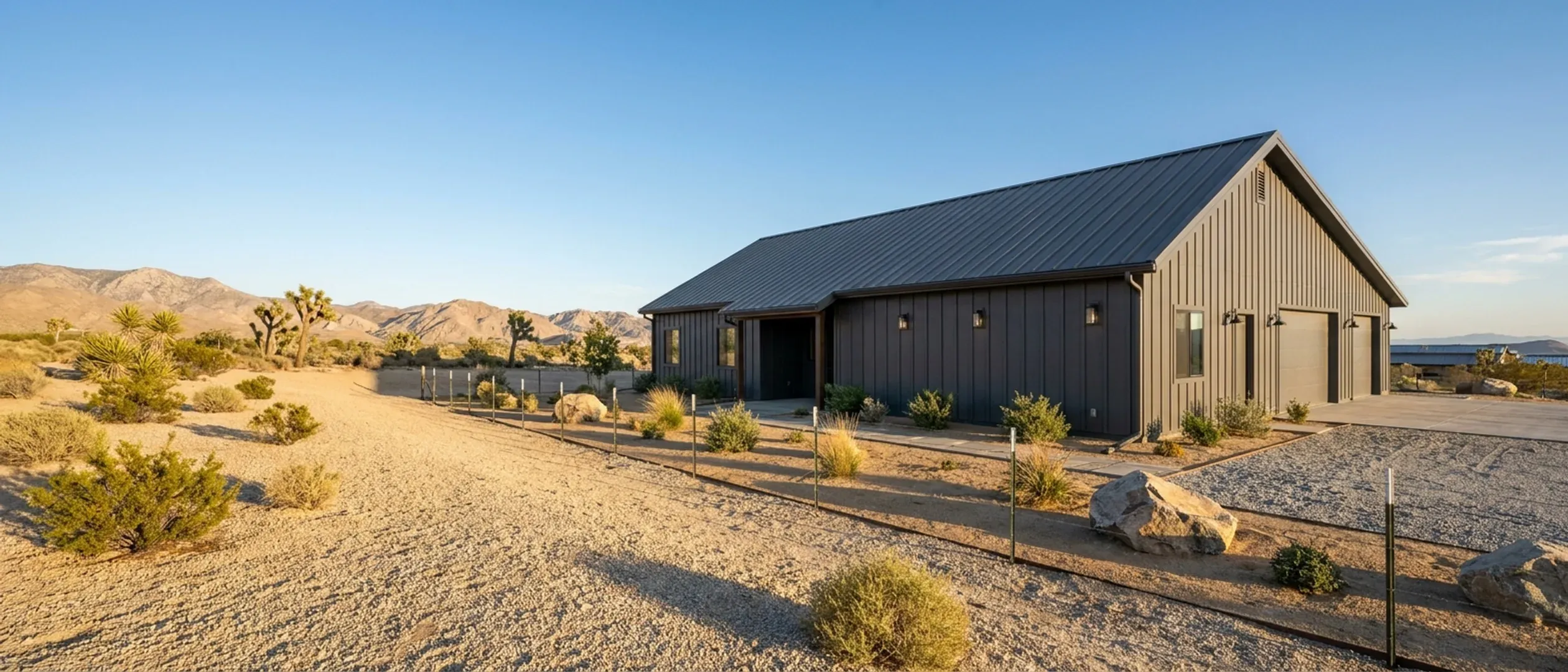
How Long Does It Take to Build a Barndominium in Nevada?
Most build-timeline pages hand you a list of stages with invented week counts. This one starts from what Nevada jurisdictions actually publish — the plan-review goals Clark County and Washoe County print for themselves, the order in which water, septic and building approvals have to happen, and the long-term temperature records for Las Vegas, Reno and Elko — and leaves the gaps honest. Two points before the stages. First, Nevada has no statewide building code; each city or county adopts its own, so there is no single state answer to how long the permit takes. Second, on raw rural land the building permit is often not the slowest step. The well, the septic approval and, in Pahrump, a water-rights purchase can take longer than the plan review, and they come first.
Figures on this page are cited third-party or government data, not a quote from Nevada Barndominium Builders.
Bottom Line Up Front
- The steel or post-frame shell goes up quickly once the pad and foundation are ready; the interior of the living space — framing, insulation, mechanicals and finishes — takes most of the calendar.
- Published review goals are short and specific: Clark County sets a 21-day first-review goal for a custom single-family residence and 10 days for each correction round; Washoe County puts a 10-business-day due date on plan reviews. Corrections rounds are what stretch them.
- Water and septic come before the foundation. A well needs a State Engineer–licensed driller, Clark County septic depends on distance from sewer, and a new domestic well in Pahrump first needs 2 acre-feet of water rights relinquished.
Published review goals — and why they are not a range
Two real numbers, printed by two Nevada building departments. They measure different things, so read what each one says before you compare them.
Clark County: 21 days for a custom single-family home's first review
Clark County's Building Department lists 'First Review Timeframe Goals': 21 days for a Custom Single Family Residence, 21 for a Standard Plan, 14 for Residential Minor work, and 10 days for 'Correction / All subsequent reviews'. The page prints them as days without saying working or calendar days, and calls them goals. A barndominium submitted as a custom home that needs two correction rounds is looking at the first review plus two ten-day rounds, plus the time you take to answer each set of comments.
Washoe County: a 10-business-day due date
Washoe County's 311 guidance says its system 'automatically places a 10-business day due date on the plan reviews', describes that as an overall goal, and notes reviews may be quicker or take longer depending on scope, with reviewers expected to notify applicants of delays. It is a due date per review, not a promise that the whole permit issues in ten days.
What neither number includes
Zoning review, health-district septic approval, water-source proof, driveway or encroachment permits, fire-district review where it applies, and HOA architectural approval all sit outside the building department's review clock. In the larger jurisdictions some of them run in parallel; on rural land several must be finished before the building application is complete.
The stages, in the order Nevada makes you do them
Durations vary too much by parcel and jurisdiction to print honestly. The order does not.
1. Land due diligence
Confirm zoning allows a single-family dwelling, the jurisdiction that will issue the permit, legal access, whether the parcel was legally created by a recorded map, and whether an HOA or CC&Rs apply. On well-and-septic land, check the water basin (and in Pahrump, whether the parcel already carries relinquished rights) and the septic authority's requirements before you close.
2. Water and septic approvals
Arrange the licensed well driller or the water service commitment, and the septic site evaluation — a test trench in Washoe County, proof of distance from sewer and of a water source in Clark County. These approvals, or at least the applications, usually need to exist before the building permit application is complete.
3. Plans and the building permit
Drawings go to the building department with the energy-code documentation and any engineered steel or truss drawings your department requires. Owner-builders also file the Nevada State Contractors Board's Owner-Builder Affidavit of Exemption with the permit application. Budget time for at least one correction round.
4. Site work and foundation
Grading, pad, utilities to the building and the foundation or post embedment. This is the stage most exposed to weather: summer heat in the south, frozen ground in the north, and flash-flood season on alluvial land.
5. Shell erection
A steel kit or post-frame package goes up quickly once materials are on site and the foundation has passed inspection. Delivery lead time for the kit itself is set by the supplier; get it in writing before you schedule the crew.
6. Interior build-out and inspections
Framing of the living space, rough plumbing, electrical and mechanical, insulation, drywall and finishes, each with its own inspection. This is the longest stage on most barndominiums and the one where owner-builders spend the most time.
7. Finals and occupancy
Final building inspection, the septic system's final approval where required before occupancy, and the certificate of occupancy or final sign-off. In Clark County the 30-day clock on a temporary RV dwelling starts at final inspection approval.
What speeds a Nevada build up — and what slows it
The difference between a smooth schedule and a stalled one is usually decided before anyone breaks ground.
Faster: a complete first submittal
Every correction round in Clark County carries its own 10-day review goal. Complete plans, energy-code paperwork and structural drawings on the first submittal remove whole rounds.
Faster: sequencing the seasons
Pouring the foundation and closing in the shell in the mild months, then finishing the interior in the heat or the cold, keeps weather off the critical path.
Slower: water rights and septic surprises
A Pahrump parcel without relinquished rights, a Clark County lot too close to sewer for a septic permit, or a failed test trench can each stop a project before it starts.
Slower: HOA review
In a planned community the architectural committee's approval is a separate queue with its own schedule, and missing the association's own construction deadlines can carry penalties under NRS 116.310305.
Reading this because you are weighing a build? The next step is a plan drawn for your program.
What's different about Nevada
Your jurisdiction sets the permit clock
Building codes in Nevada are adopted by cities and counties (NRS 278.580), so plan review, inspection sequences and permit expiry rules are local. Outside Clark County, a city's stricter code can also reach up to a mile beyond its limits (NRS 244.368), which changes which office reviews a parcel on the edge of town. Before you build a schedule, confirm which department issues your permit, how long its first review and correction rounds are expected to take, and how long the permit stays active once issued.
Water decides whether the schedule starts at all
A domestic well for one home within 2 acre-feet a year needs no water-right permit (NRS 534.180(1)), but it must be drilled by a driller licensed by the State Engineer (NRS 534.160), who keeps a log and reports it (NRS 534.170). In the Pahrump Artesian Basin, State Engineer Order 1293A adds a step in front of the driller: obtaining and relinquishing at least 2 acre-feet of existing water rights, unless the parcel's rights were already relinquished. That purchase belongs at the very start of the timeline.
Septic approval comes before the house
Residential septic in Nevada is approved by local health authorities or county building departments. Northern Nevada Public Health begins Washoe County approvals with a test-trench inspection. The Central Nevada Health District, covering Fallon and Churchill, Eureka, Mineral and Pershing counties, issues system permits valid for one year and inspects the system before occupancy. In Clark County the Southern Nevada Health District issues new residential septic permits only for lots more than 400 feet from the nearest sewer connection point, with proof of an approved water source — paperwork to assemble before the building application.
Southern Nevada summers set the hours of the day
The Western Regional Climate Center's long-term record for Las Vegas McCarran Airport puts the mean daily high at 104.5°F in July and 102.3°F in August (period-of-record means, file updated April 2013). Crews in that heat typically shift concrete pours and heavy steel erection to the early morning, and fresh concrete needs protection from rapid drying. Expect summer to slow some trades rather than stop the job, and ask your contractor how they plan pours in July and August.
Northern winters set the season
The same record puts the mean January low at 20.9°F at the Reno airport station and 10.9°F at Elko Regional Airport. Frozen ground and cold-weather concrete protection make winter foundation work slower and costlier in northern and northeastern Nevada, so a common plan is to have the foundation poured and the shell closed in before the cold months, then finish the interior through winter. Frost depth and snow load for your footing and roof come from your local building department, not from a statewide figure.
Other clocks you may not expect
In a common-interest community the association may impose a construction penalty if you miss its schedule for design, start of construction, completion or the occupancy permit (NRS 116.310305). In Clark County an RV used as a temporary dwelling during construction is limited to 24 months from building permit issuance or 30 days after final inspection approval, whichever comes first (Title 30). Owner-builders who plan to live on site should build that deadline into the plan.
Pros and cons, honestly
Pros
- The steel or post-frame shell is erected quickly once the foundation passes inspection.
- Clark County and Washoe County publish their plan-review goals, so you can plan around real numbers.
- A domestic well within 2 acre-feet a year needs no water-right permit in most basins, which removes a long approval.
- Dry southern winters allow year-round work in the Las Vegas Valley.
Cons
- There is no statewide permit timeline; every jurisdiction sets its own.
- Correction rounds add their own review time to every published goal.
- Well, septic and, in Pahrump, water-rights steps must come before the foundation.
- Summer heat in the south and winter cold in the north both constrain concrete work.
- HOA construction schedules and Clark County's 24-month temporary-dwelling limit add deadlines of their own.
How long does it take to build a barndominium in Nevada?
How long is plan review for a house in Clark County?
How long is plan review in Washoe County?
Do I need the well before I can get a building permit?
Does Pahrump take longer?
Can I build a barndominium in the Las Vegas summer?
Can I build through a northern Nevada winter?
How long can I live in an RV on my land while building?
Questions answered? Tell us about your land and what you want to build.
Sources
- Clark County Building & Fire Prevention — Plan Review Timelines — First Review Timeframe Goals; read 26 Sep 2026
- Washoe County 311 — How long does it take for my plans to be reviewed? — 10-business-day due date; read 26 Sep 2026
- Western Regional Climate Center — Las Vegas McCarran AP monthly average maximum temperature — period-of-record means, file updated 4 Apr 2013
- Western Regional Climate Center — Reno Tahoe Intl AP monthly average minimum temperature — period-of-record means, file updated 4 Apr 2013
- Western Regional Climate Center — Elko Regional AP monthly average minimum temperature — period-of-record means, file updated 4 Apr 2013
- NRS Chapter 534 — Underground Water and Wells (Nevada Legislature, Rev. 4/15/2026; archived copy) — 534.160, 534.170, 534.180
- Nevada Division of Water Resources — State Engineer Order 1293A — Pahrump Artesian Basin
- Central Nevada Health District — ISDS programme — permit validity and pre-occupancy inspection
- Northern Nevada Public Health — Septic and Liquid Waste — test-trench inspection first
- Clark County — Title 30 Unified Development Code (latest amendment Nov 20, 2024) — Temporary Dwelling standards
- NRS Chapter 116 — Common-Interest Ownership (archived copy) — 116.310305 construction penalties
Keep reading
The pages that answer the next question this one raises.
Are barndominiums legal in Nevada?
Who issues the permit, the owner-builder exemption, wells, septic and HOA rules.
Read itPermitting help
Assembling the approvals that come before and with the building permit.
Read itSite preparation
Pads, grading, wells and septic on raw Nevada land.
Read itFinancing a barndominium in Nevada
How construction-loan draws line up with the stages of the build.
Read itRanges are a starting point. Your land is the answer.
Start the survey and tell us about your land and what you want to build. Include the county and parcel ID if you have them, because in Nevada the jurisdiction, the water source, the septic answer and how far materials travel to the parcel change the budget more than the building does. The survey costs nothing.